



Put a hot crucible on a standard laminate bench and you'll learn a quick lesson about thermal limits. The surface scorches, delaminates, and off-gasses. In Russia's industrial labs — metallurgy, ceramics, petrochemical testing, nuclear materials analysis — high temperatures aren't accidents. They're the daily workflow. Your bench needs to handle that without flinching.
HJSLab, a laboratory equipment manufacturer based in Suzhou, China, produces stainless steel lab benches specifically engineered for high-temperature industrial environments. The company offers two grades — 304 and 316L — each with different thermal ceilings and corrosion profiles.
304 vs 316L: Picking the Right Grade
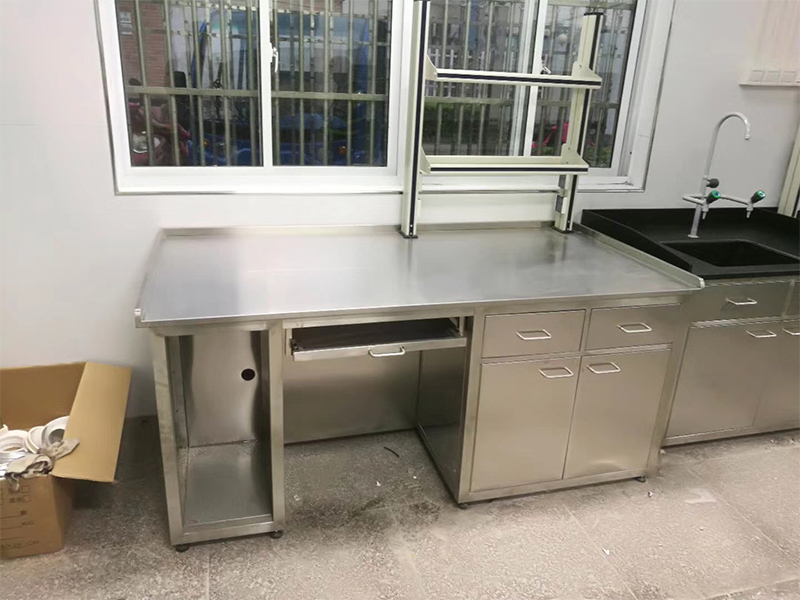
304 stainless steel handles continuous service temperatures up to 870°C. That covers most industrial lab applications — sample preparation after furnace runs, hot plate work, and thermal cycling tests. It's the workhorse grade, widely available and cost-effective.
316L pushes the ceiling to 925°C and adds molybdenum for superior resistance to chloride corrosion. If your lab handles salt-laden samples, marine materials, or acidic solutions at elevated temperatures, 316L is worth the premium. The "L" means low carbon — 0.03% max — which prevents carbide precipitation during welding and keeps the heat-affected zone corrosion-resistant.
Countertop Construction for Extreme Heat
HJSLab's standard stainless steel countertop is 1.5mm thick — adequate for general lab work up to 400°C surface contact. For high-temperature applications, the company offers 2.0mm and 3.0mm options. Thicker steel means more thermal mass, which spreads heat laterally and prevents hot spots from warping the surface.
Underneath the steel top, HJSLab installs a ceramic fiber insulation layer for benches designated as high-temperature rated. This does two things: it protects the steel frame and cabinet below from conducted heat, and it prevents the bench surface from becoming a giant radiator that heats up the entire room.
Welding Technology That Matters at High Temperature
Welds are the weak link in any stainless steel structure exposed to heat cycling. HJSLab uses argon arc welding (TIG) for all stainless steel joints. Argon shielding prevents oxidation during welding, which means no chromium depletion at the weld zone and no intergranular corrosion later. Every weld is ground smooth and polished — not for aesthetics, but because rough weld beads create stress concentration points that crack under thermal cycling.
China's Stainless Steel Advantage
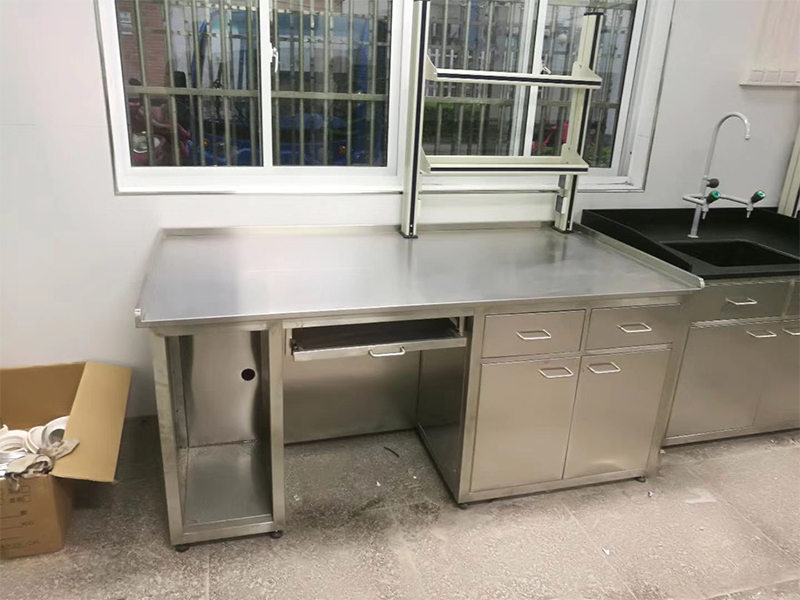
China is the world's largest stainless steel producer — over half of global output. This gives Chinese manufacturers like HJSLab direct access to raw material at prices European fabricators can't match. HJSLab's Suzhou factory passes that advantage along: their stainless steel benches cost 30 to 40 percent less than comparable European products, with the same material grades and certifications.
Getting It to Russia
Two main routes. Rail from Suzhou to Moscow takes about 18 days via the Trans-Siberian corridor. Sea freight to Vladivostok is faster — 5 to 7 days — and works well for labs in Russia's Far East. HJSLab ships in flat-pack form with Russian and English assembly documentation. Material certificates showing exact alloy composition, heat treatment records, and welding procedure qualifications ship with every order.
If your industrial lab in Russia works with high temperatures and you're tired of replacing warped or damaged bench surfaces, talk to HJSLab. They'll spec a stainless steel bench matched to your exact temperature range, chemical exposure, and load requirements.